

Dr. Gustavo Suárez · The doctor’s blog
Scars after nostril reduction: where they sit and how they change
Alar base reduction involves incisions and scars. Understand where these may be placed, why their appearance changes during healing and which questions help weigh up surgery before proceeding.
Written by Dr. Gustavo Suárez · Reviewed by Dr. Gustavo Suárez on
Read the article Read the articleNostril reduction leaves scars where the incisions are made. Their position is planned to limit visibility, but the outcome also depends on how the skin heals. Before deciding, it is useful to understand both the intended change in shape and where the necessary scars will sit.
Alar base reduction requires an individual assessment. Scarring should be part of that discussion, with an explanation related to the person's anatomy and expectations.
Where might the incisions be placed?
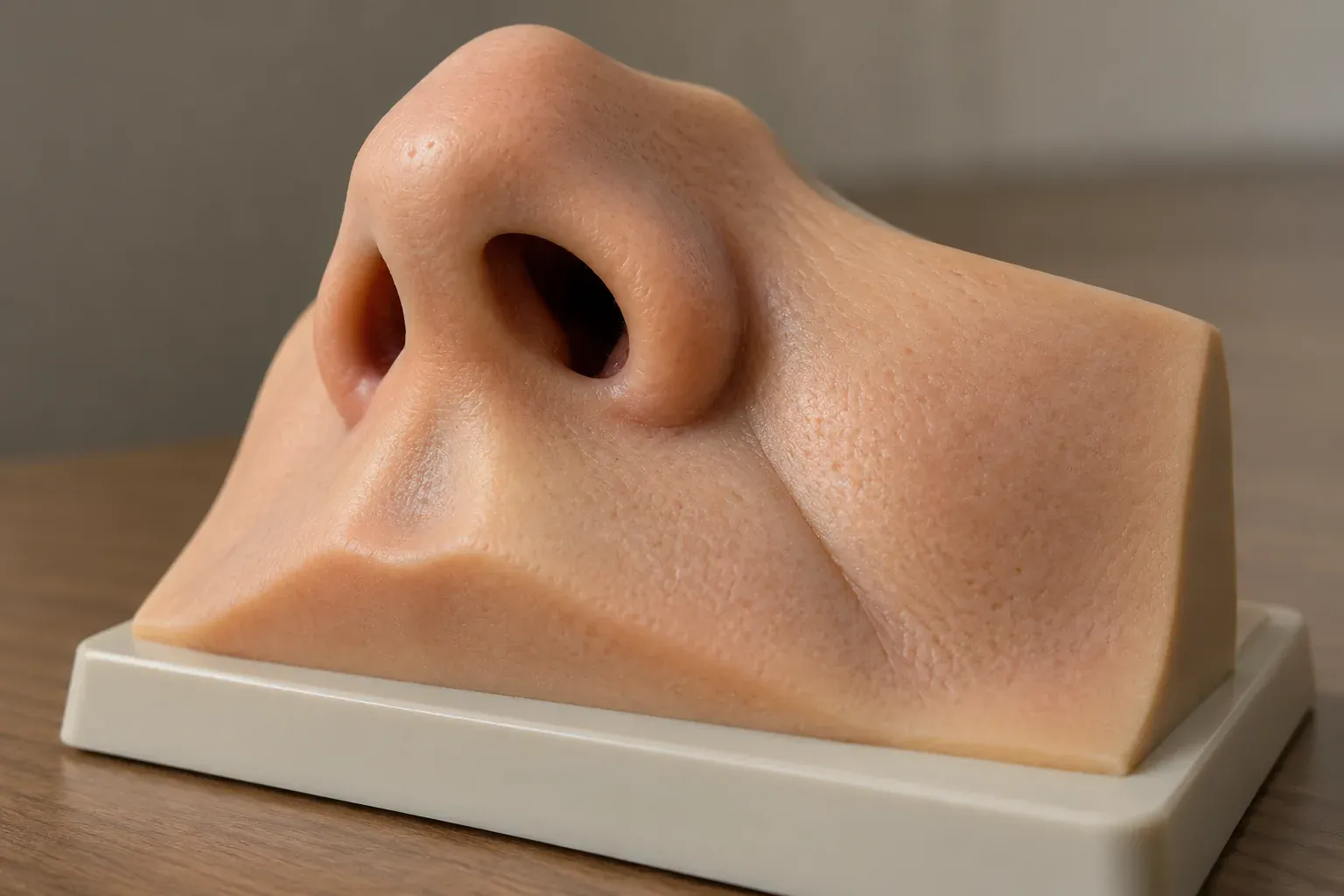
The nasal alae are the side portions of the nose surrounding the nostril openings. Depending on the planned correction, incisions may be positioned at their base, near the crease where they meet the face, and may involve the lower part of the nostril opening.
SECPF explains that narrowing the nostril openings may require small incisions at the base of the nasal alae. The exact position depends on the procedure. Asking the surgeon to indicate the proposed incision lines makes the discussion more concrete.
An alar base scar is different from the incision between the nostrils that may be used in open rhinoplasty. These have different locations and purposes. If procedures are combined, it helps to ask which incisions each one requires.
What does placing an incision in a natural crease achieve?
Positioning an incision near a crease aims to blend it into existing contours. Visibility also depends on the scar's colour, width, texture and development, as well as its location.
Planning aims for a less noticeable scar but cannot guarantee an imperceptible one. Useful questions include which viewing angles might reveal the scar and which features of the skin or planned operation influence that assessment.
How does the scar change as it heals?
An early scar looks different from a mature one. Colour, firmness and elevation may change during healing. NHS guidance on scars describes them as tending to fade over time, with variation in their progress and final appearance. This is general information about scar development, rather than a prediction specific to alar base reduction.
Wound closure and later scar maturation are separate stages. A closed wound can still have a visible mark that continues to change. Follow-up therefore assesses progress over time rather than judging the outcome from the earliest appearance alone.
There is no identical timetable for everyone. The team should explain which changes are expected and when they should be reviewed.
What is assessed before surgery?
Previous healing provides useful information. The consultation should include any history of particularly raised or wide scars and any wound-healing problems after earlier procedures.
Smoking, conditions that affect healing and regular treatments also belong in the medical history. Wound location and the characteristics of the proposed operation are relevant too.
These details help inform the discussion but cannot predict the final appearance with certainty. Assessment should relate them to the expected benefit of reducing the alar base.
Which aftercare instructions should be clear?
Written advice should cover wound care, follow-up and protection from sunlight. Any product, massage or specific scar treatment needs to be appropriate for the stage of healing and advised by the team.
Scar appearance continues to change over time, as described by the NHS. Care should match the stage of healing rather than assuming the same measures apply from the beginning.
It should also be clear what to do if the wound becomes uncomfortable or changes. The team familiar with the operation can advise according to the condition of the area.
Risks and questions before deciding
The operation carries risks that should be explained in relation to the proposed technique and individual assessment. Increasing redness or pain, discharge or wound opening warrants contact with the team to assess healing.
If a scar becomes troublesome, the MedlinePlus page on scar revision provides general information about surgical treatment. It concerns ways of treating certain scars, rather than their natural maturation. Any additional treatment requires assessment of the scar and its progress first.
Before proceeding, ask where each incision will be, what might remain visible, how follow-up is organised and how a troublesome scar would be assessed. Individual consultation helps weigh the intended change against the scarring involved, without promises of invisibility.
Keep reading

Is hyaluronidase safe? Understanding the risks of dissolving filler
Dissolving hyaluronic acid filler is a medical decision in its own right. Understand the risks and limitations of hyaluronidase, what to discuss beforehand and which details to bring to an assessment.
Eye bags: why they appear and when surgery is considered
Eye bags mainly appear with age: the tissues around the eye lose firmness and the fat that protects it moves towards the lower eyelid. Lack of sleep, allergies, smoking, salt or family inheritance can make them more visible. When the bag is caused by fat and excess skin, the surgery that treats it is lower blepharoplasty. If what you see in the mirror is a hollow under the eye or dark discolouration, the approach is different.
Prominent ears: why they occur and how they are corrected at each age
Prominent ears stand out from the head more than usual. Typically, the antihelix is insufficiently folded (the fold running through the ear inside its outer rim), the concha is deeper than usual, or both. In a newborn, there is a non-surgical option, ear moulding, which works best the earlier it begins within the first weeks of life. After that stage, correction is by otoplasty: in selected children it is considered from age 6 or 7, and adolescents and adults can also have surgery.
Further reading
More
information.
Back to the blog
More articles to prepare for your consultation.
Request a consultation
Contact Dr. Gustavo Suárez.